





In today’s competitive digital marketplace, businesses need fast and measurable ways to reach their target audience. That’s where Online Advertising Guide: Google Ads, Facebook Ads & PPC Marketing Explained becomes essential. Online advertising allows businesses to drive traffic, generate leads, and increase sales with precision targeting and measurable results.
Unlike traditional marketing, online ads give you control over budget, audience, timing, and performance tracking. When managed correctly, they deliver strong returns on investment and scalable growth.
This comprehensive guide explains how Google Ads, Facebook Ads, and PPC (Pay-Per-Click) marketing work, and how you can use them effectively.
What Is PPC Marketing?
PPC (Pay-Per-Click) marketing is an online advertising model where advertisers pay a fee each time someone clicks their ad.
Instead of earning traffic organically, you buy visits to your website.
Key benefits of PPC:
- Immediate traffic
- Targeted audience reach
- Measurable results
- Budget control
- Scalable campaigns
PPC platforms include search engines, social media networks, and display advertising systems.
Understanding PPC fundamentals is the foundation of Online Advertising Guide: Google Ads, Facebook Ads & PPC Marketing Explained.
Part 1: Google Ads Explained
Google Ads is one of the most powerful PPC platforms available. It allows businesses to show ads on Google search results, YouTube, and partner websites.
1. How Google Ads Works
Google Ads operates on a bidding system. Advertisers bid on keywords related to their business. When users search for those keywords, Google runs an auction to determine which ads appear.
Your ad position depends on:
- Bid amount
- Quality Score
- Ad relevance
- Landing page experience
Higher Quality Scores lower your cost per click (CPC).
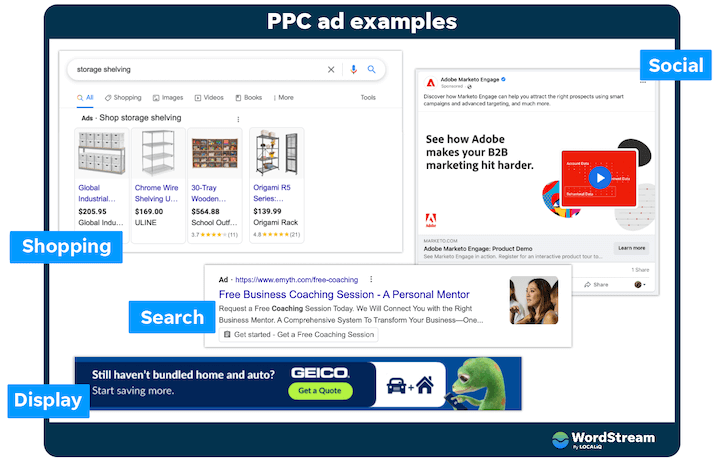
2. Types of Google Ads Campaigns
Search Ads
Text ads that appear on Google search results pages. Ideal for high-intent users.
Display Ads
Visual banner ads that appear on websites within Google’s network.
Shopping Ads
Product listings with images and prices. Best for e-commerce businesses.
Video Ads
Ads shown on YouTube.
Performance Max
Automated campaigns that use machine learning across all Google channels.
Each campaign type serves a different marketing goal.
3. Keyword Research for Google Ads
Effective keyword research is critical.
Focus on:
- High-intent keywords (e.g., “buy running shoes online”)
- Long-tail keywords (more specific and less competitive)
- Negative keywords (to avoid irrelevant clicks)
High-intent keywords convert better and reduce wasted budget.
4. Creating High-Converting Google Ads
Strong ads include:
- Clear headline
- Relevant keywords
- Strong call-to-action
- Unique selling proposition
- Ad extensions (site links, call buttons, location info)
The goal is to match user intent and encourage clicks.
5. Optimizing Google Ads Campaigns
Monitor:
- Click-through rate (CTR)
- Cost per click (CPC)
- Conversion rate
- Cost per acquisition (CPA)
- Return on ad spend (ROAS)
Optimization involves:
- Adjusting bids
- Testing ad variations
- Improving landing pages
- Refining keywords
Consistent optimization improves performance over time.
Part 2: Facebook Ads Explained
Facebook Ads allow businesses to target users based on demographics, interests, and behaviors.
Unlike Google Ads (which target search intent), Facebook Ads focus on audience targeting.
1. How Facebook Ads Work
Facebook Ads run on an auction system similar to Google Ads.
Advertisers define:
- Target audience
- Budget
- Campaign objective
- Ad creative
Facebook then shows ads to users most likely to take action.
2. Campaign Objectives
Common objectives include:
- Brand awareness
- Traffic
- Engagement
- Lead generation
- Conversions
- Sales
Choosing the right objective is essential in Online Advertising Guide: Google Ads, Facebook Ads & PPC Marketing Explained.
3. Audience Targeting on Facebook
Facebook offers advanced targeting options:
- Age
- Gender
- Location
- Interests
- Behaviors
- Job titles
- Income level
You can also create:
- Custom audiences (website visitors, email lists)
- Lookalike audiences (similar to existing customers)
This precise targeting increases conversion rates.
4. Creating Effective Facebook Ads
Successful ads include:
- Attention-grabbing visuals
- Short, compelling copy
- Clear benefits
- Strong call-to-action
- Mobile-friendly design
Video ads often perform better than static images.
Testing different creatives is essential.
5. Facebook Pixel and Tracking
The Facebook Pixel is a tracking code placed on your website.
It tracks:
- Page views
- Purchases
- Add-to-cart actions
- Lead submissions
Pixel data helps:
- Optimize campaigns
- Retarget visitors
- Create custom audiences
Without tracking, performance cannot be measured accurately.
Part 3: Comparing Google Ads and Facebook Ads
Both platforms have strengths.
Google Ads
Best for:
- High-intent searches
- Immediate conversions
- Local services
- E-commerce
Users are actively searching for solutions.
Facebook Ads
Best for:
- Brand awareness
- Lead generation
- Product discovery
- Retargeting
Users may not be searching, but ads appear in their feed.
In many cases, combining both platforms delivers the best results.
This integrated approach is a key principle of Online Advertising Guide: Google Ads, Facebook Ads & PPC Marketing Explained.
Budgeting for Online Advertising
Start with a manageable budget.
Example approach:
- Allocate 60% to proven campaigns
- Allocate 20% to testing new audiences
- Allocate 20% to creative experiments
Never launch ads without a clear strategy.
Set daily or monthly caps to control spending.
Landing Pages Matter
Your ad is only half the equation. The landing page must convert visitors.
A strong landing page includes:
- Clear headline
- Strong value proposition
- Social proof (reviews, testimonials)
- Clear call-to-action
- Simple form or checkout process
- Fast loading speed
Improving landing page experience lowers advertising costs and increases conversions.
Retargeting: The Secret to Higher Conversions
Most users do not convert on the first visit.
Retargeting allows you to show ads to:
- Website visitors
- Cart abandoners
- Video viewers
- Email subscribers
Retargeting campaigns often have higher conversion rates and lower costs.
This strategy significantly improves ROI.
Measuring PPC Success
Key metrics to track:
- Impressions
- Click-through rate (CTR)
- Conversion rate
- Cost per acquisition (CPA)
- Return on ad spend (ROAS)
- Customer lifetime value (LTV)
Focus on profitability, not just traffic.
Data-driven decisions improve long-term performance.
Common PPC Mistakes to Avoid
When implementing Online Advertising Guide: Google Ads, Facebook Ads & PPC Marketing Explained, avoid these mistakes:
- Targeting too broad an audience
- Ignoring negative keywords
- Not tracking conversions
- Poor landing page design
- Running ads without testing
- Stopping campaigns too early
- Focusing only on clicks instead of sales
Patience and optimization are key.
Scaling Successful Campaigns
Once a campaign is profitable:
- Gradually increase budget
- Expand to new audiences
- Test new creatives
- Launch complementary campaigns
- Optimize based on data
Avoid sudden budget spikes. Scale gradually to maintain performance.
When to Hire a PPC Specialist
Consider professional help if:
- Budget exceeds your expertise
- Campaign performance is declining
- You lack time for optimization
- You need advanced tracking
Experienced marketers can improve ROI and reduce wasted spending.
Final Thoughts
Mastering Online Advertising Guide: Google Ads, Facebook Ads & PPC Marketing Explained gives businesses the power to generate immediate traffic, measurable results, and scalable growth.
To summarize:
- Understand how PPC works.
- Use Google Ads for high-intent searches.
- Use Facebook Ads for audience targeting and brand building.
- Create compelling ad copy and visuals.
- Optimize landing pages.
- Track and analyze performance.
- Retarget visitors to increase conversions.
- Scale gradually and strategically.
Online advertising is not about spending the most money. It is about targeting the right audience with the right message at the right time.
With proper strategy, testing, and optimization, Google Ads, Facebook Ads, and PPC marketing can become powerful tools for driving consistent business growth.